
Prostate Wellness Educational Guide
Support Your Prostate Wellness: An Educational Guide Feeling off-balance or drained doesn’t have to be part of getting older. Often,

General Introduction
Practitioner Manual & Advanced Training introduces the highest level of mastery in the CombiHs Herbalism Book series. This volume equips readers with advanced diagnostic intelligence, deeper taste–energy insight, and structured procedures for ethical, accurate, and transformative healing work.
Each chapter empowers practitioners to assess organs confidently, design precise formulas, treat complex disorders, and manage chronic imbalances with predictable outcomes. You will also learn how to guide patients, train new practitioners, document cases professionally, and build convincing research evidence.
Volume V moves you from knowledge to mastery, providing every tool required to practice CombiHs Herbalism with confidence and measurable results.
Advanced diagnostic, formulation, documentation, teaching, and professional herbal practice system.
Every practitioner represents the CombiHs model. Therefore, the CombiHs Herbalism Book demands strict integrity, accurate diagnosis, and patient-focused correction. Practitioners must act with discipline, loyalty, and unwavering respect for patient safety.
Write your ethical code today and commit to disciplined, safe, patient-centered herbal therapy.
Accurate consultation ensures correct diagnosis, proper formulation, and safe therapeutic outcomes.
Design a professional consultation form and test it on five supervised clients to refine your assessment skill.
Advanced formulation blends taste, energy, organ affinity, and disease stage for precision healing.
Create five advanced formulas and track patient outcomes carefully to refine proportions.
Many patients present with multiple organ–taste imbalances. Staged care prevents system overload and improves outcomes.
Pattern: Sweet and salty cravings indicating pancreas and kidney imbalance.
Stage 1: Bitter leaf + dandelion + licorice
Stage 2: Add guava leaf + ginger
Result: Blood sugar stabilized and water retention reduced.
Apply staged therapy in all multi-organ cases and document every adjustment.
Correct preparation increases extraction efficiency and therapeutic accuracy.
Practice three preparation methods using five herbs and record your results.
Educated patients maintain long-term healing and prevent relapse.
Create a patient education booklet and train at least five people to track taste patterns.
Future practitioners depend on your clarity, accuracy, and teaching skill.
Organize a taste-evaluation workshop and teach students to design corrective formulas.
Professional practice requires accurate, consistent, and ethical records.
Create a case-tracking template and document at least three complete cases.
Strong evidence builds trust, credibility, and professional recognition.
Start a taste-based observational study and document outcomes consistently.
Use these tools daily and educate patients using structured, repeatable systems.
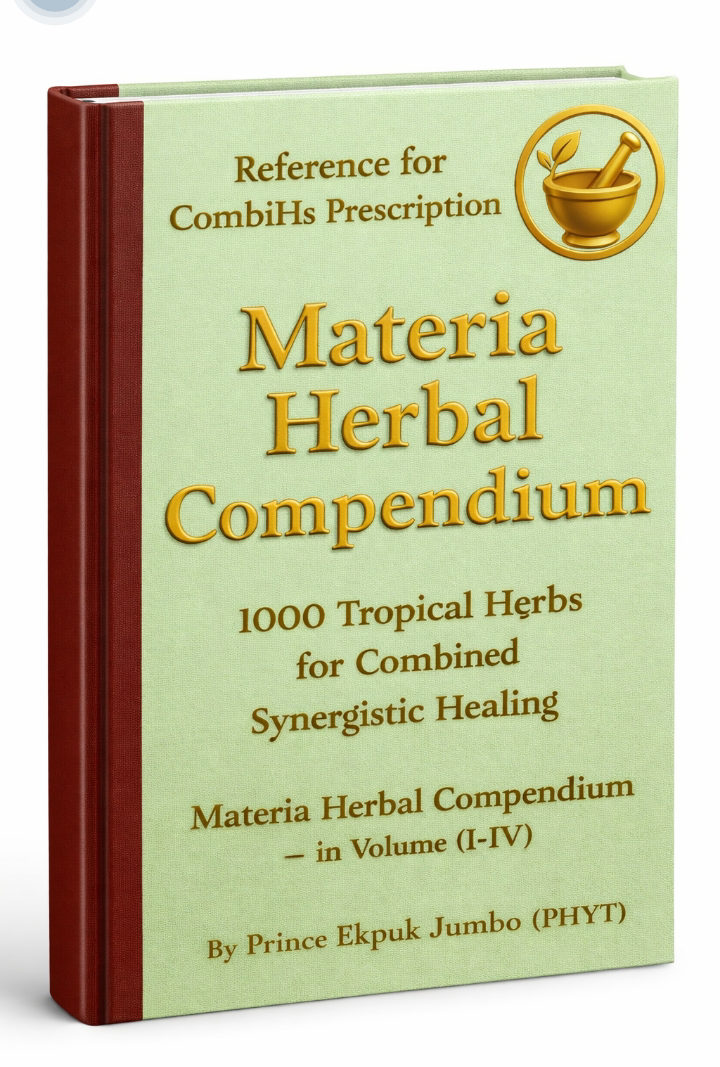
Prince Ekpuk Jumbo (PHYT) transforms traditional herbal wisdom into practical, science-aligned healing systems. Through the CombiHs Herbalism Book series, he equips families, students, and practitioners with taste–energy diagnosis, organ correction methods, and safe herbal protocols. His mission is to empower home-care healing and guide students toward professional herbal mastery with clarity, confidence, and proven results.
CombiHs Herbalism Book — Volume V is your advanced home-care and practitioner guide for preventing and treating illness caused by taste excess and organ stress. Families use it daily, students rely on it for training, and practitioners apply it for measurable healing outcomes.
Begin your mastery now.
Medium Publication
Tropical Herbs NG
Support Your Prostate Wellness: An Educational Guide Feeling off-balance or drained doesn’t have to be part of getting older. Often,
Know Your Potent Herbs: Achyranthes aspera13126-1 Achyranthes aspera, commonly known as prickly chaff flower or devil’s horsewhip, is identified by

We deliver core herbal procedure cures for our users for better and more efficient health value.
