CombHs Herbal Soap
CombHs Herbal Soap You may benefit from using CombiHs Herbal Soap as part of your skincare regimen. The soap’s herbal
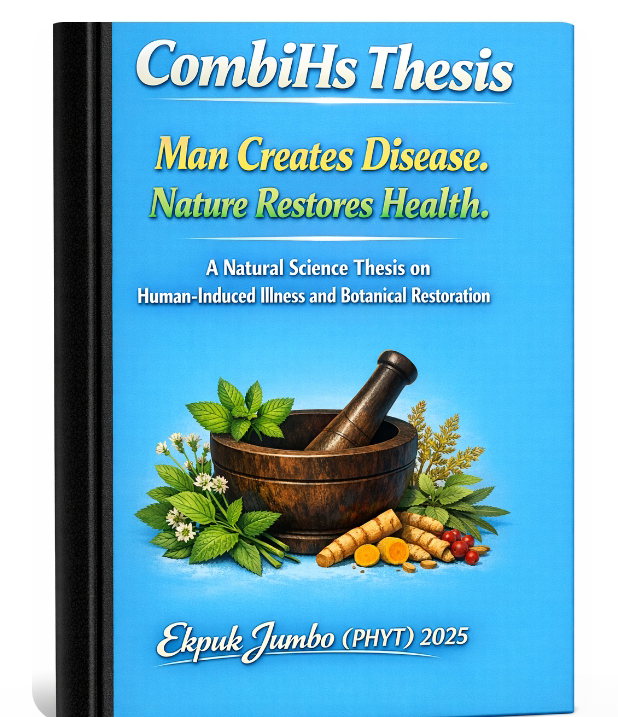
There was a time in human history when the body was not feared.
A time when illness was not hunted, suppressed, or silenced, but understood.
A time when the human system was seen as intelligent, adaptive, and responsive to its environment.
In that period, disease did not represent invasion or failure.
Disease served as a signal.
This preface establishes the foundation of Man Creates Disease Nature as a biological principle, not a metaphor.
Modern health narratives often present disease as random, genetic, or unavoidable.
History, traditional medicine, and natural observation present another reality.
Disease increased because human behavior changed, not because nature shifted.
Nature did not become hostile. Humanity became excessive.
This thesis advances a simple and resistant premise:
Most modern ailments arise from human-created imbalance.
Healing remains natural, biological, and supported by botanical intelligence.
This work does not reject science, technology, or emergency medicine.
Instead, it asks a foundational question:
Why do bodies fail earlier and more frequently despite expanded medical intervention?
Nature operates through balance.
The human body reflects that structure across digestive, hormonal, immune, circulatory, and nervous systems.
Repeated excess, deficiency, or unnatural combinations force the body to adapt.
That adaptation later receives the name disease.
Disease never begins the process.
Disease ends the process.
Long before diagnosis, the body communicates clearly:
Earlier cultures respected these signals.
Modern systems silence them.
This thesis affirms that chronic illness reflects cumulative biological abuse, not sudden malfunction.
Food is not the enemy.
Drink is not the enemy.
Energy is not the enemy.
Misuse is.
Human physiology requires food for repair, energy, signaling, and structure.
When processing removes enzymes, minerals, fiber, and phytonutrients, food loses biological intelligence.
Excessive intake, poor combinations, and improper timing convert nourishment into burden.
A life-supporting substance can still become an instrument of disease when removed from its natural context.
Compensation follows misuse.
Compensation becomes exhaustion.
Exhaustion becomes disease.
That disease remains man-created.
Modern health culture often treats the body as fragile.
Reality shows resilience, adaptability, and tolerance.
The body does not fail easily. It fails last.
Symptoms do not represent error.
Symptoms communicate.
Suppressing symptoms without addressing cause silences the messenger.
The message remains.
Healing is not mystical. Healing is biological.
Nature provides substances that regulate inflammation, restore minerals, support organs, and assist detoxification.
Herbs do not oppose the body.
They cooperate with it.
Traditional systems recognized this through outcome, not terminology.
Herbal medicine is remembered biology.
This thesis rejects cure-all thinking.
However, modern life reveals repeated abuse patterns:
Where abuse becomes general, restorative strategy may also become general.
CombiHs responds to abuse, not disease.
Humanity did not suddenly weaken.
Nature did not suddenly fail.
The relationship changed.
When balance returns, health follows as consequence.
Man creates disease. Nature restores health.
Outbound reading:
medium.com/@ekpukjumb
Inbound reference:
Tropical Herbs NG
CombHs Herbal Soap You may benefit from using CombiHs Herbal Soap as part of your skincare regimen. The soap’s herbal

We deliver core herbal procedure cures for our users for better and more efficient health value.
